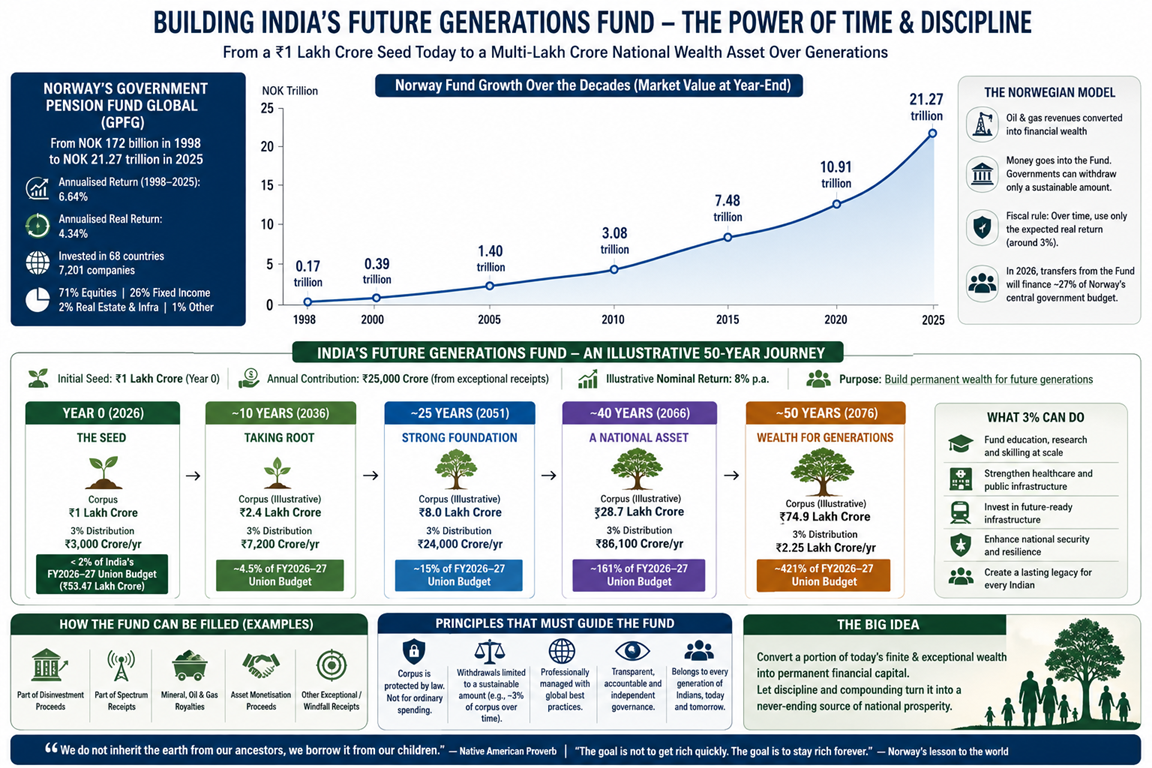
On India's 80th Independence Day, the question isn't what we won. It's what we do with it.
Eighty years ago, a generation fought for something they knew they wouldn't fully get to enjoy — freedom. Nevertheless, it was won mostly for the people who came after them. That's worth sitting with for a second, because it's the same decision I want to talk about today, just in a financial form.
Imagine a country that suddenly starts receiving a huge amount of money from a finite natural resource. There are only two ways to handle that.
The first is easy: spend it. Build roads, raise government salaries, fund welfare schemes, cut taxes. Make life better for people today — which is understandable, and politically almost irresistible.
The second is harder. Take the money and invest it. Don't touch the capital. Let it compound for decades and spend only a sustainable slice of the return each year to support the budget.
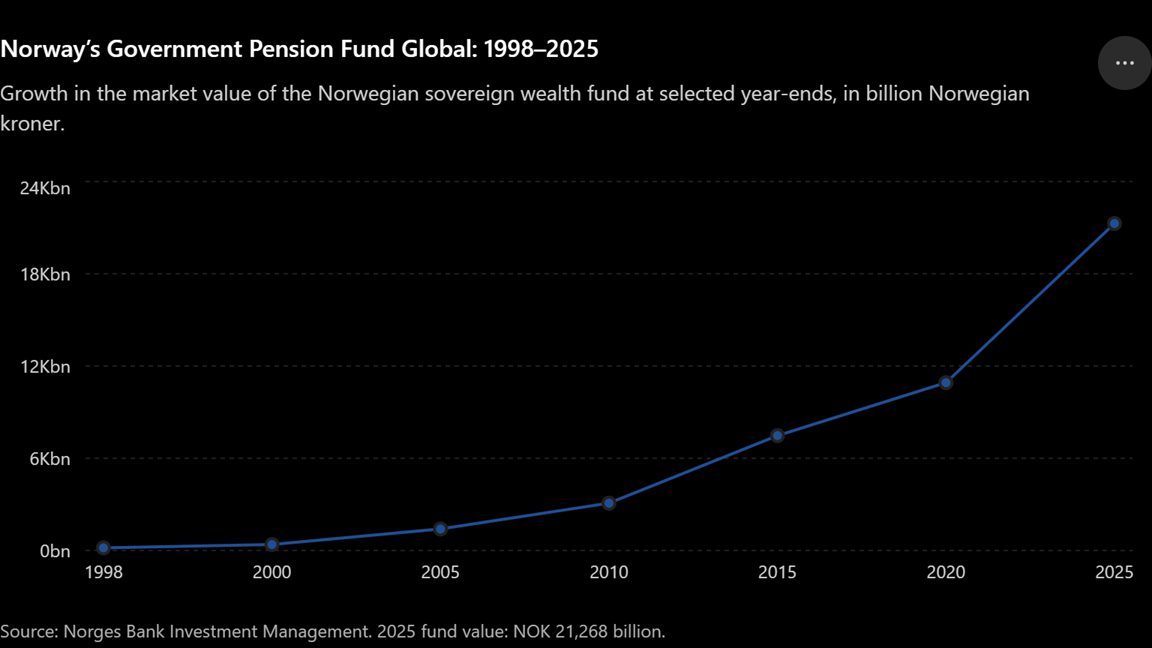
Norway chose the second path with its oil wealth, and the result has been extraordinary. The Government Pension Fund Global — what most people just call the Norwegian Oil Fund — was worth roughly NOK 21.27 trillion at the end of 2025. Since 1998 it has returned about 6.64% annually, or roughly 4.3% after inflation and costs.
But the size isn't really the interesting part. The philosophy is. And on a day when we're celebrating eight decades of a freedom that was itself a gift to future generations, that philosophy raises a genuinely interesting question for India: could we build something similar? Not a copy — India is too different in population, economy and fiscal structure for that — but the underlying idea might still be worth taking seriously.
Norway's great financial experiment
When Norway discovered oil and gas in the North Sea, it could easily have treated the revenue as ordinary government income. Instead, it built a different philosophy: convert petroleum wealth into financial wealth.
The Fund was established in 1990, with the first capital arriving in 1996, to manage petroleum revenue for the long term so that a resource being pulled out of the ground today could still benefit generations who haven't been born yet. Net petroleum cash flow goes into the Fund automatically. Money only comes back out through a parliamentary decision. That distinction — oil converted into financial assets rather than spent as it arrives — is really the whole idea in one sentence.
Today those assets sit in 68 countries and 41 currencies: about 71% equities, 27% fixed income, and the rest split between unlisted real estate and renewable infrastructure, spread across more than 7,200 companies. Which is why the popular line "Norway owns all the shares in the world" is an exaggeration — it doesn't — but it does own a small sliver of thousands of companies across the global economy, on the simple logic that if you can't predict which companies will win over the next 30 years, you might as well own a diversified piece of all of them.
The 3% rule, properly understood
This part gets misunderstood a lot. Norway doesn't have a rule that says "withdraw exactly 3% every year." The actual fiscal rule links government spending, over time, to the Fund's expected real return — currently estimated around 3%. In good years, withdrawals stay below that, leaving room to spend more when the economy needs it. That estimate used to be 4%, and was lowered to 3% in 2017.
Why 3%? Because if the portfolio's long-run real return is around 3%, spending roughly that amount should let the underlying capital hold its value indefinitely. The key word is "over time" — it's a sustainability principle, not a rigid annual ceiling. And it's become a serious part of Norway's finances: in 2026, Fund transfers are expected to cover around 27% of the central government's budget. A resource that could have been burned through decades ago is now quietly financing more than a quarter of the country's spending.
What the compounding actually looks like
Of the Fund's NOK 21.27 trillion, only about NOK 5.42 trillion came from actual capital contributions. The other roughly NOK 13.46 trillion is investment returns — meaning the money the Fund made is now bigger than the money that was put in. That's what happens when capital compounds for thirty years: the early years look unremarkable, and then at some point the returns start generating their own returns, and growth stops being about contributions and starts being about math. Individual investors learn this about their own portfolios. Norway just applied it at the scale of an entire country.
So where does India fit in?
India doesn't have Norway's oil, and this is where we have to be careful about the comparison. We're still a capital-hungry economy — we need enormous investment in infrastructure, manufacturing, energy, railways, defence, education, healthcare. Norway, with a small population and a massive petroleum surplus, could afford to park a huge share of its wealth overseas. India can't simply copy that.
But India does have its own version of "one-time wealth": spectrum, mineral resources, oil and gas, mining royalties, government land, public-sector assets, disinvestment proceeds, asset monetisation, occasional windfall receipts. Much of this becomes ordinary fiscal revenue and gets spent. The question worth asking, especially today, is whether some portion of it should instead become permanent financial capital — a kind of independence for the India of 2076, secured by the India of 2026.
We already have a fund — just not this kind of fund
India has the National Investment and Infrastructure Fund (NIIF), which does important work pulling capital into commercially viable infrastructure projects. But NIIF is an investment and infrastructure platform, not Norway's Government Pension Fund Global. The distinction matters.
What I'm describing is different in purpose. Not "how do we fund another government project," but "how do we convert a slice of today's exceptional national wealth into capital that benefits Indians thirty or fifty years from now."
What an Indian version could look like
Call it the India Future Generations Fund, or something like it — the name matters less than the mechanics. It would collect a defined share of genuinely exceptional, non-recurring receipts: a portion of disinvestment proceeds when a government stake is sold; a slice of spectrum auction revenue, since once a block is sold that particular opportunity is gone forever; a share of natural-resource royalties; part of asset-monetisation proceeds; and a predefined cut of any exceptional windfall receipts.
Deliberately not ordinary income-tax or GST revenue — we need that to run the country today. The idea is narrower: capture wealth that is finite or one-time and convert part of it into something permanent.
Start small, on purpose
We don't need to launch this with ₹10 lakh crore. Trying to would probably be politically and fiscally unrealistic anyway. Suppose India started with ₹1 lakh crore. Against the Union Government's FY2026–27 expenditure of roughly ₹53.47 lakh crore, that's under 2% — barely a rounding error.
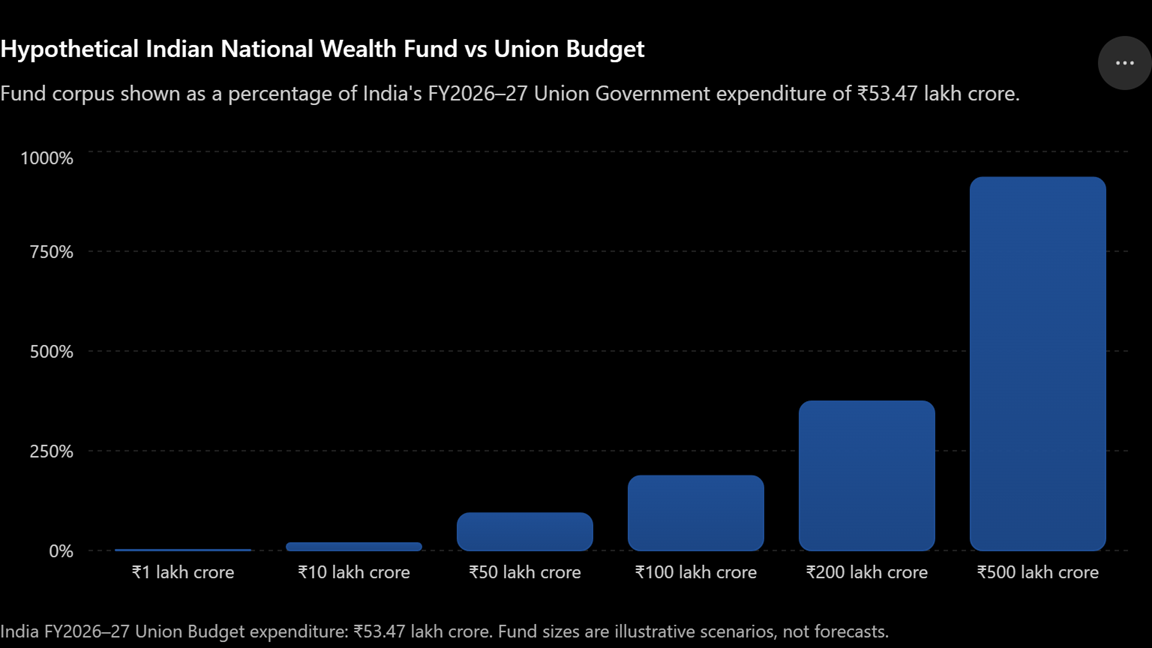
That's actually the point. A fund this size wouldn't fix any of today's fiscal problems, which is exactly why it might be politically easier to get off the ground. It isn't meant to solve today's budget. It's meant to start tomorrow's balance sheet.
From there, the key is an automatic contribution rule — a defined percentage of qualifying disinvestment, spectrum, mineral, petroleum and asset-monetisation receipts flowing in every year without a fresh political decision each time. If every contribution needs to be re-argued annually, the fund won't survive changing priorities. The whole point is to build a national savings habit that runs on autopilot.
Don't touch the corpus
This is where Norway's discipline really matters — and where it echoes something we already understand instinctively about August 15th: some things you protect precisely because they belong to people who haven't arrived yet.
At a hypothetical 3% distribution: a ₹10 lakh crore fund throws off ₹30,000 crore a year — meaningful, not transformative. At ₹50 lakh crore, that's ₹1.5 lakh crore. At ₹100 lakh crore, ₹3 lakh crore. At ₹500 lakh crore, ₹15 lakh crore. These aren't forecasts — they're just the arithmetic of compounding, showing why that first ₹1 lakh crore matters. It's not the destination. It's the seed.
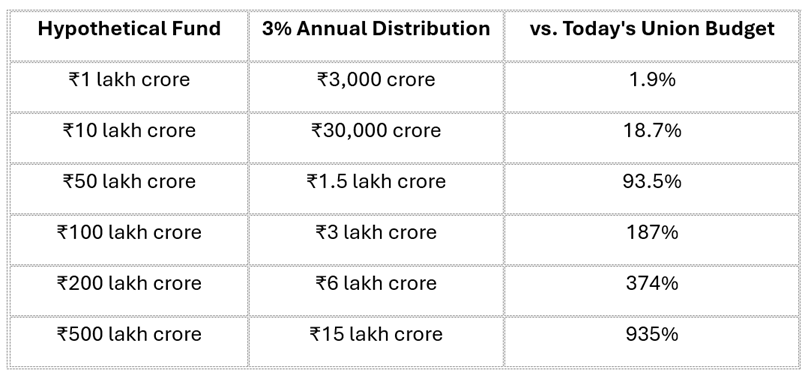
One caveat worth stating clearly: it isn't fair to compare a fund thirty years out against today's budget, since government expenditure will have grown too. The right goal isn't "build a fund equal to today's budget" — it's "build a fund whose sustainable income becomes a meaningful share of future government expenditure."
Where the money should actually go
Borrowing again from Norway: the fund shouldn't become a disguised way to finance government pet projects. It needs a clear mandate and professional management at arm's length from politics. I'd split it into two portfolios.
The first, call it India Development Capital, would fund commercially viable Indian infrastructure, energy, manufacturing and technology — but only investments that clear a genuine commercial bar, not ones that are politically convenient.
The second, and larger, portfolio should go global. India's citizens are already overexposed to India — their jobs, property, businesses, savings and taxes are all tied to the same economy. A sovereign fund invested abroad would actually diversify that risk, which is one of the underrated strengths of Norway's approach. There's also a practical reason to invest outside India: a huge pool of domestic capital chasing a limited set of domestic assets is a recipe for bubbles, inflation and currency pressure. National wealth doesn't have to mean money invested only inside the nation.
The fund has to be politically fireproof
This might be the hardest part. Building a sovereign wealth fund is easy. Building one that survives fifty years of political change is not — and if there's one thing eighty years of Indian democracy has taught us, it's that institutions only outlast governments when they're deliberately built to.
Picture a future government facing a fiscal crunch, looking at ₹100 lakh crore sitting in the Future Generations Fund, and asking why they shouldn't just withdraw ₹10 lakh crore. That single moment could unravel the entire philosophy. Which is why the fund needs a real legal firewall: the corpus shouldn't ordinarily be touchable, only the predefined sustainable distribution flows to the budget, and any exceptional withdrawal should require a genuinely high bar — parliamentary approval, independent fiscal assessment, a formally declared emergency. The exact legal architecture is a job for constitutional and fiscal experts, but the principle is simple: this fund needs to be harder to raid than the ordinary treasury.
Whose money is it, really?
There's a common misconception about Norway worth clearing up: people say every Norwegian owns a piece of the Oil Fund, but that's not literally true — the state owns it. Still, the sentiment captures something real. The fund isn't meant to belong to whichever government happens to be in power. It's national capital held in trust for people who haven't been born yet.
For India, that reframing matters, and it isn't unfamiliar. It's close to how we already think about the freedom we're celebrating today — not owned by any one generation, held in trust and passed forward intact. This shouldn't be thought of as "government money" — it should be thought of as capital held in trust for future Indians. That's a different psychology entirely
The one mistake to avoid
It would be a mistake to look at Norway's 6.64% return since 1998 and assume India could simply replicate it. That number is a historical outcome, not a promise — the Fund lost about 14.1% in 2022 and gained 15.1% in 2025. A sovereign fund has to be built to survive the bad years, which means no chasing short-term performance, no political interference, no leverage-driven bets, no crowding into whatever's fashionable, and no assumption that every year will be a good one. The time horizon has to be measured in decades, not political terms.
The lessons, in short
Convert finite wealth into permanent wealth — oil, minerals and spectrum all get consumed, but the financial capital built from them doesn't have to. Separate saving from spending, so that wealth creation and today's budget aren't the same conversation. Think in generations rather than five-year political cycles — a government elected today shouldn't get to spend resources that belong economically to citizens born twenty years from now. Diversify globally, since India's economic future is already overexposed to India. And let compounding do the heavy lifting: the goal isn't to build a ₹100 lakh crore fund today, it's to build a system that can eventually produce one.
The deeper point
People call the Norwegian model an "oil fund," but that framing misses what actually made it work. Norway's real innovation wasn't finding oil — that was luck. The innovation was deciding what to do with the wealth it created, essentially deciding that the resource belonged not just to the current generation, but to the ones after it too.
India's resources look different — spectrum, minerals, disinvestment proceeds, asset sales — but the same question applies: how much of this exceptional, one-time wealth should we consume today, and how much should we convert into something permanent?
Picture 2026: India sets up a Future Generations Fund with ₹1 lakh crore. Over the next fifty years, successive governments contribute a defined share of exceptional receipts. The fund is professionally managed, survives multiple governments, several recessions, a few wars, and plenty of political change — and just keeps compounding. By 2076 — India's 130th year of independence — India has inherited a financial asset worth hundreds of lakh crores, one no government actually owns in the conventional sense — only holds in trust, drawing a sustainable income from it before passing the capital on intact.
India doesn't need to become Norway. We're too big, too diverse and too developmentally different for the model to transplant directly. But the principle underneath it is universal — a family can apply it, a university can apply it, and so can a country: don't consume every windfall, convert some of it into productive capital, and let time do what discipline alone can't.
Eighty years ago, one generation decided that freedom was worth securing for people they'd never meet. Norway did something quieter but structurally similar with petroleum. India could do it with a broader basket of national assets and exceptional receipts. And maybe the real lesson, on a day built entirely around what one generation leaves for the next, is simpler than any of the numbers above: wealth isn't what you earn — it's what you retain, invest, and pass on.
India didn't win its freedom to spend it in on one generation. Maybe its wealth deserves the same discipline.