
How do Indian Markets behave during wartime or short conflicts? Lessons from recent conflicts
Cdr S Thankappan (Retd), CFP®
Wars and geopolitical tensions dominate news cycles and often trigger panic among investors. When missiles fly and borders heat up, the natural assumption is that stock markets will collapse.
But history tells a far more nuanced story. A study of several conflicts over the past three decades shows that Indian equity markets typically experience short-term volatility during geopolitical crises but often recover surprisingly quickly once uncertainty begins to decline.
Let us examine how Indian markets behaved during some of the most significant military conflicts affecting India and the global economy.
Data Source
Market data used in this analysis has been compiled from publicly available sources including the National Stock Exchange of India, BSE Ltd, Nifty 50, and BSE Sensex historical datasets. Additional price series were accessed through publicly available financial databases such as Yahoo Finance for visualization and analytical purposes. Historical event timelines were compiled from widely reported public records and global news archives.
The python file used for generation of the insights is Markets_and_Wars.ipynb - Colab
Kargil War (1999): Markets rose despite the conflict
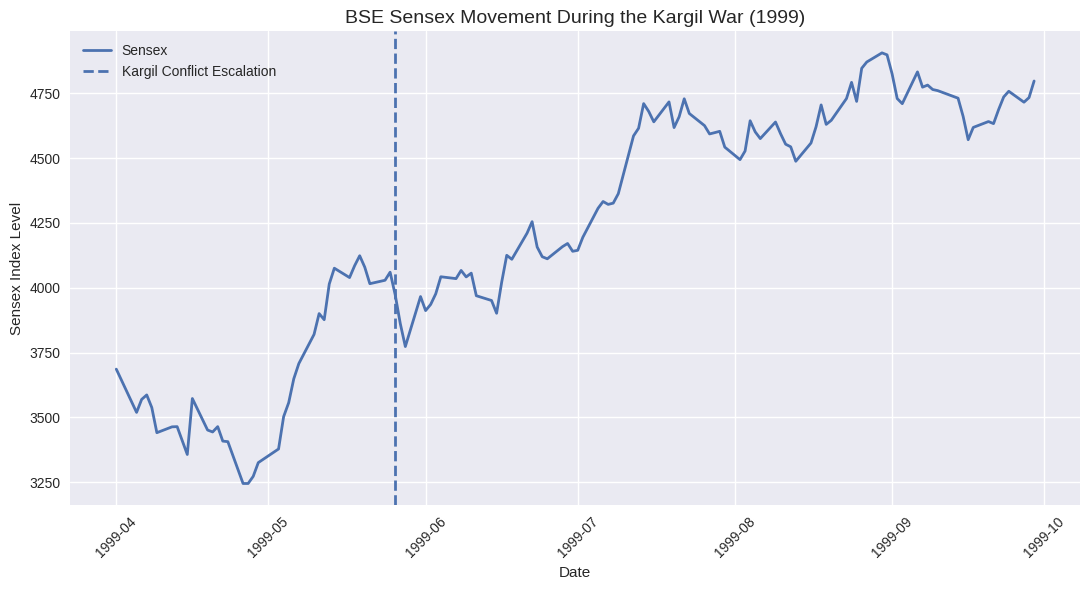
The Kargil War between India and Pakistan (May–July 1999) remains one of the most interesting examples of wartime market behaviour. Contrary to expectations, Indian markets performed strongly during this period.
Key observations:
· The BSE Sensex rose significantly during the conflict period.
· Investor confidence improved once it became clear that the war was geographically limited.
· The Indian economy was already benefiting from the structural reforms of the 1990s.
The key takeaway: Markets tend to react more to economic fundamentals than to military headlines, especially when conflicts remain contained.
Second Gulf War (2003): Shock followed by refocus on underlying economic conditions
The Gulf War triggered global economic uncertainty, particularly due to rising oil prices.
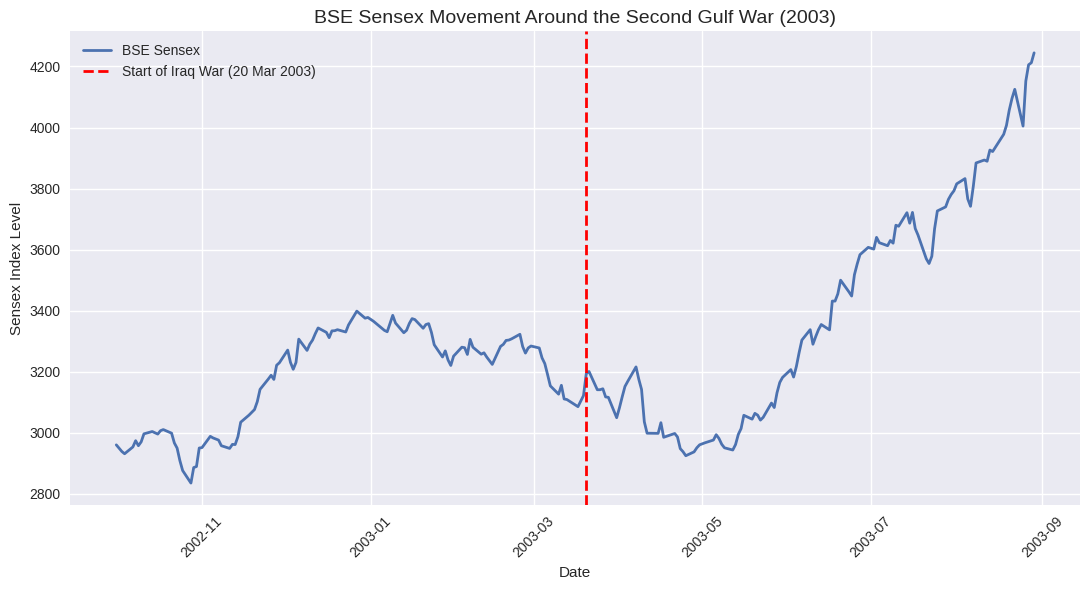
During the War in 2003, the BSE Sensex experienced noticeable volatility in the months leading up to the conflict. Rising geopolitical uncertainty and concerns over global economic stability caused markets to remain cautious in early 2003. However, once the U.S.-led invasion of Iraq began in March 2003 and the scope of the conflict became clearer, investor sentiment improved. The Sensex began to recover and moved higher in the following months as global markets stabilized and economic fundamentals regained focus.
The episode highlighted a recurring pattern in financial markets: Geopolitical shocks may trigger short-term volatility, but markets often recover once uncertainty declines and investors refocus on underlying economic conditions.
Indo–Pak Military Events (2019)
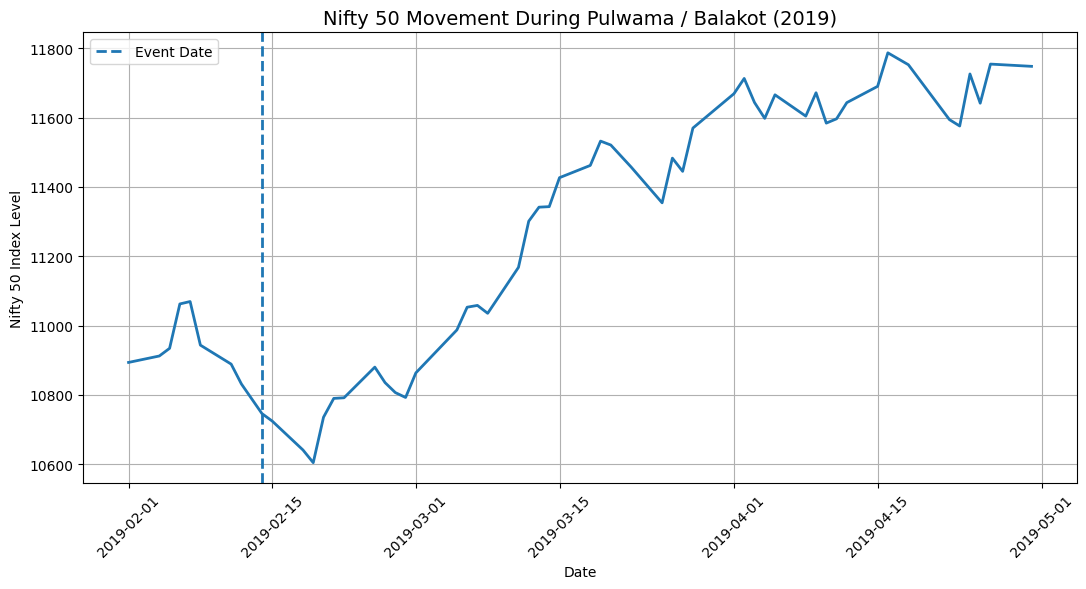
India experienced several security incidents during this period, including the 2019 Pulwama attack followed by the Balakot airstrikes. Despite the emotional intensity of these events, market reactions were short-lived. The Nifty 50 saw temporary declines but quickly recovered.
This period highlighted an important shift in Indian markets: Investors increasingly view geopolitical incidents as temporary shocks rather than structural economic threats.
India–China Border Clash (Galwan Incident, 2020)
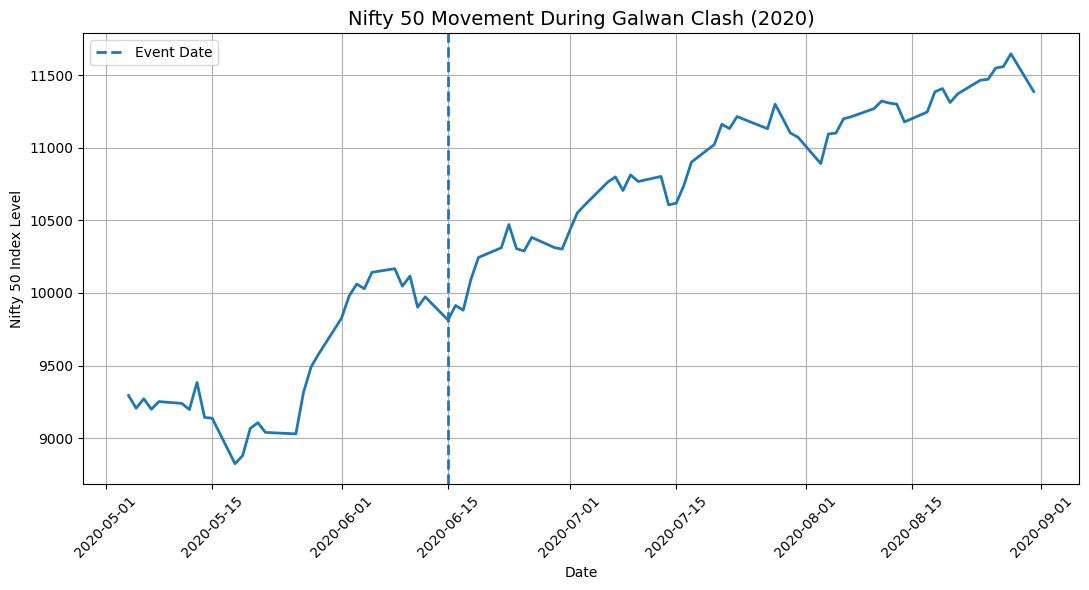
In June 2020, tensions escalated dramatically between India and China following the Galwan Valley clash in Ladakh. Despite the geopolitical seriousness of the event, market reactions were relatively contained. The Nifty 50 experienced short-term volatility but quickly resumed its upward trend. Several factors helped limit the impact:
· Strong liquidity from global central banks during the pandemic
· Continued domestic investor participation
· Confidence that the conflict would remain localized
The incident reinforced a broader market principle: Markets react more strongly to systemic economic disruptions than to localized geopolitical tensions.
Russia–Ukraine War (2022): Global shock, rapid stabilisation
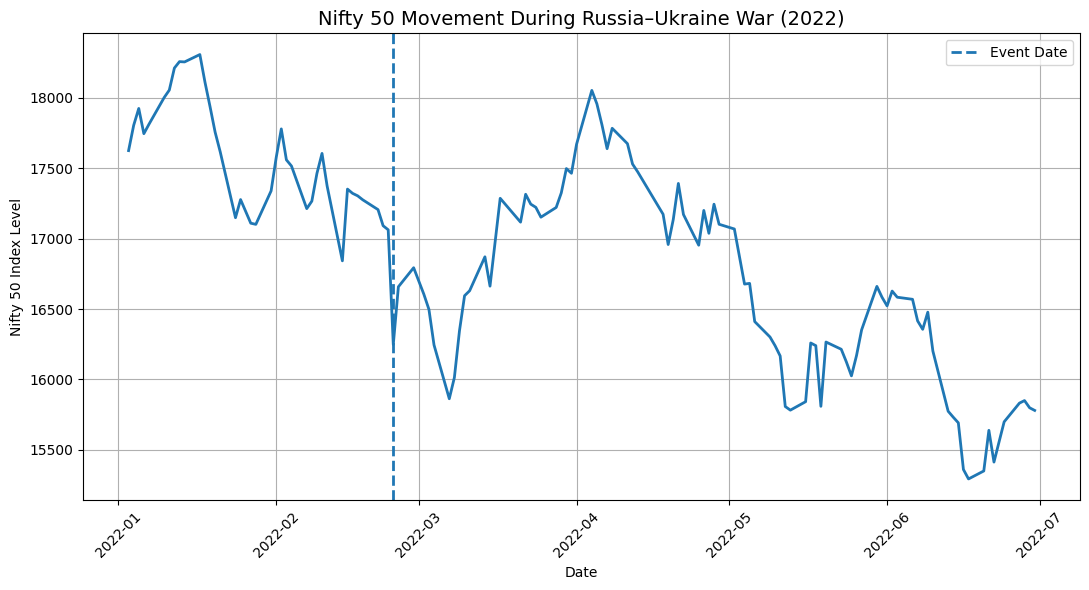
The Russia–Ukraine War, which began in February 2022, created one of the largest geopolitical shocks in recent decades. Global markets reacted sharply.
In India:
· The Nifty 50 dropped roughly 10–12% in the weeks following the invasion.
· Foreign institutional investors sold heavily in emerging markets.
· Crude oil prices surged above $120 per barrel.
However, the recovery was relatively swift. Several factors helped stabilize Indian markets:
· Strong domestic liquidity
· Rising retail investor participation
· Consistent inflows into mutual funds via SIPs
One of the most notable developments during this period was the growing influence of domestic investors, who absorbed selling pressure from foreign investors.
Indo–Pak Skirmish (2025): Limited market impact
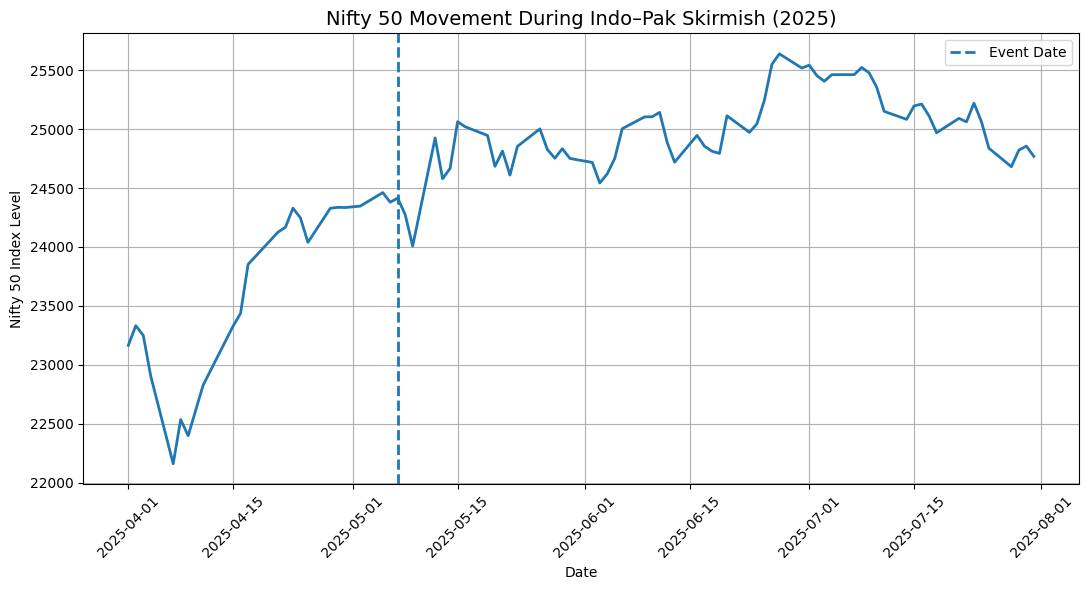
The recent 2025 India–Pakistan border skirmishes also tested market sentiment. As tensions rose along the border, markets initially displayed mild volatility. However, the broader impact on Indian equities remained limited. Why?
Three structural factors now support market resilience:
1. Large domestic institutional investor base
2. Regular SIP inflows from retail investors
3. Strong economic growth expectations
These forces increasingly cushion Indian markets against external shocks.
The Real Wartime Risk for India: Oil
While wars themselves may not derail Indian markets, their economic consequences can matter significantly. For India, the most important transmission channel is crude oil. Because India imports over 80% of its oil requirements, geopolitical conflicts in energy-producing regions can affect:
· Inflation
· Currency stability
· Fiscal balance
This explains why markets sometimes react more to oil price spikes than to the conflict itself.
A Clear Pattern: How markets behave during wars
Across multiple conflicts, a consistent pattern emerges.
Phase 1 – Rising Uncertainty. Markets often decline before or during the early stages of a conflict.
Phase 2 – Shock and Volatility. News flow intensifies and volatility spikes.
Phase 3 – Stabilisation. Markets stabilise once the scale and duration of the conflict become clearer.
Phase 4 – Recovery. If economic fundamentals remain intact, markets resume their long-term trend. In many cases, markets recover within weeks or months.
What Investors Should Learn
Historical evidence suggests three key lessons.
1. Panic rarely pays. War-related market declines are often temporary.
2. Volatility is normal. Short-term shocks are part of investing.
3. Fundamentals ultimately dominate. Economic growth, corporate earnings, and policy stability drive long-term returns.
Conclusion
History shows that wars generate headlines, fear, and volatility, but rarely alter the long-term trajectory of equity markets unless they fundamentally reshape global economic systems. For investors, the greater risk during geopolitical crises is not the war itself, but the emotion-driven investment decisions made during periods of fear most certainly are. Markets eventually move past wars. But portfolios damaged by panic selling can take much longer to recover.
Disclaimer
This analysis is intended solely for educational and informational purposes. The data and charts presented are based on historical market performance and should not be interpreted as investment advice or a prediction of future market behaviour. While reasonable care has been taken in compiling the data, accuracy and completeness cannot be guaranteed. Market reactions to geopolitical events may vary depending on economic conditions, policy responses, and investor sentiment at the time.